Help
How this works, and what we do not know.
Deployment, evidence, limits, rollback and billing for a self-hosted evaluation. Readable before you sign in; nothing here depends on your workspace.
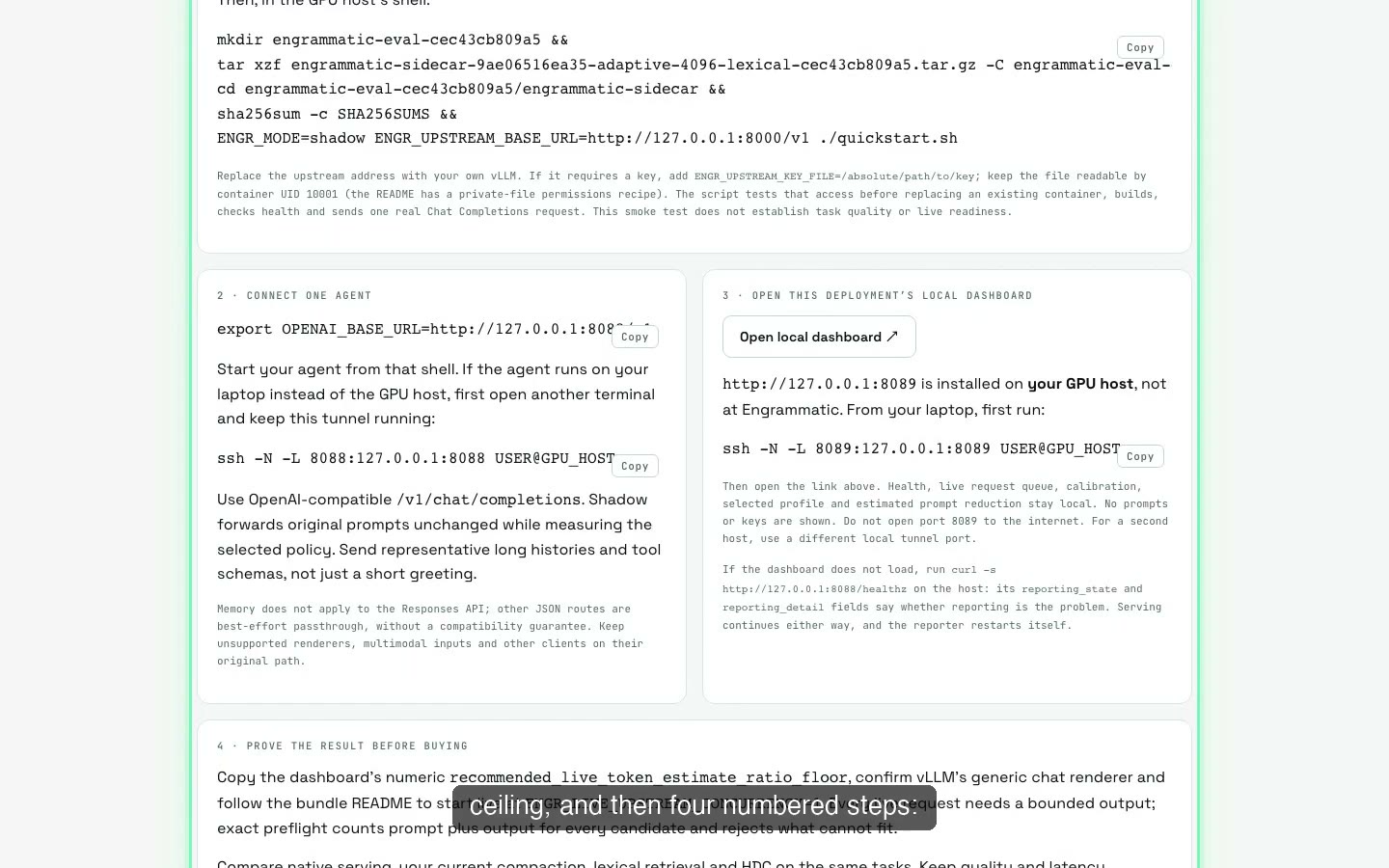
One film shows the whole path on the console as it ships, narrated and subtitled: Fleet Audit, the evaluation workspace, the three memory profiles, the browser download, the install block, connecting one agent, the installed local dashboard, calibration and the licence. Size, download, install and license the Memory Sidecar →
Start hereThe evaluation path, in order
Six steps. Each one is reversible, and nothing changes in your infrastructure before step three.
Size it
On Fleet Audit enter session slots, the peak active share, the longest history a session reaches, your GPU, model preset, KV precision, your own compute rate and the cards assigned to this workload. The result is a modelled range of resident sessions per replica, the cards this load would need and the annual licence at the published rate. It is not a measurement.
Configure and download
Create this evaluation carries every input into a workspace (sign-in is an email). Choose the memory profile, then Download the sidecar: a source bundle whose file name carries the workspace, the profile and a build identity. Saving a profile changes the next download only; it never touches a running host.
Install in shadow
Copy the archive to a Linux GPU host with Docker and an already-serving vLLM, extract it into a fresh directory, run
sha256sum -c SHA256SUMS, then the quickstart with your model address. Success means one real Chat Completions request came back through the proxy. Shadow forwards every prompt unchanged and measures what the policy would have kept.Connect one agent
Change the agent's base URL to
http://127.0.0.1:8088/v1on the host, or throughssh -N -L 8088:127.0.0.1:8088 USER@GPU_HOSTfrom a laptop. Send representative long histories and tool schemas, not a greeting. Open the installed dashboard on port 8089 the same way.Calibrate, then live at one
After representative shadow traffic the dashboard and
/metricsgiverecommended_live_token_estimate_ratio_floor. Set it, attest the generic renderer, give every request an output limit, and restart in live mode with one admitted request. Then test 2, 4, 8 and 16, stopping at the highest stage that passes your quality and latency gates.Prove it, then license
Compare native serving, your current compaction, lexical retrieval and HDC on the same tasks, then declare the GPU cards that will run the sidecar on the Licence page. Nothing is charged until Stripe Checkout completes; rollback is one base-URL change.
CompatibilityWill it fit your stack?
Memory treatment applies to one route on one kind of server. Everything else either passes through or stays out of scope; the sidecar never guesses.
| Supported today | Not covered by this early-access integration |
|---|---|
Self-hosted vLLM (tested against 0.11.2) using its generic chat renderer, with the local
/tokenize route reachable from the sidecar |
Hosted model APIs (OpenAI, Anthropic, Bedrock and similar): you do not control the GPU, so there is nothing to size or install |
Text-only /v1/chat/completions, streaming or not, including function-calling tools |
The Responses API, multimodal message parts, documents, and tools sent with an explicit
tool_choice=none (best-effort passthrough only) |
| Open-weight text models that render through the generic chat template (the Qwen3 and Llama families, for example) | GPT-OSS/Harmony and Mistral-specialized rendering: their prompts cannot be counted exactly before generation, so they stay in shadow |
| A Linux host with Docker, the model already serving, the agent on the host or reaching it through an SSH tunnel | Other servers (TGI, Ollama, llama.cpp, SGLang): shadow may run, live refuses because there is no equivalent exact-count route |
Loopback listeners, by default 8088 (proxy, ENGR_PORT) and 8089 (dashboard, ENGR_REPORT_PORT); a client key when you deliberately widen the bind |
Publishing either port, several sidecars sharing one admission limit, or the sidecar governing traffic that bypasses it |
InstallWhat the quickstart does, and what each failure means
The quickstart is four numbered steps: check your vLLM, build the image, start the container, then a real Chat Completions request through the proxy. It fails loudly rather than half-starting.
| Exit | What you see | Cause | Do this |
|---|---|---|---|
| 2 | A setting is missing or invalid: no ENGR_UPSTREAM_BASE_URL, an unknown mode or profile value,
live without a ratio floor or renderer attestation, a non-loopback bind without a client key, or Docker not installed |
Configuration checked before anything is built | Fix the variable named in the message and re-run. No container was changed. |
| 3 | /models returned 401 or 403, cannot be reached, or the key file is not readable by container user 10001 |
Your model server, its key, or the key file permissions | Check the address from the host, pass ENGR_UPSTREAM_KEY_FILE,
and use the README's private-file recipe (owner you, group 10001, mode 640). No container was changed. |
| 4 | The container started but /healthz never answered, or the smoke request failed; the last 40 log lines are printed |
The sidecar itself, or a model that answers /models but not chat | The previous sidecar container was replaced at this point. Keep the agent on its original model URL while you read the logs; re-run once fixed. |
| 0 | "Serving on http://127.0.0.1:8088/v1 in shadow mode", the policy, the admission limits, the dashboard URL and the rollback line | One real completion came back through the proxy | Connect one agent and send representative traffic. A short smoke is not calibration. |
Two things a fresh cloud host taught us: the login user is often not in the docker group
(sudo usermod -aG docker $USER, then log in again, or every docker call is "permission denied"), and vLLM 0.11
prints the value of --api-key in its startup log, so pass the key as the VLLM_API_KEY environment variable instead.
Expect a first install to take under a minute once the model is serving and the base image is cached (41 seconds on an H100 host
in our own run), five to fifteen minutes when the image build has to download packages.
By default the proxy listens on 8088 and the dashboard on 8089, both on loopback; ENGR_PORT, ENGR_REPORT_PORT and
ENGR_CONTAINER_NAME let a second replica's sidecar share the host. Re-running the quickstart replaces the
container (docker rm -f engrammatic-sidecar) after its checks pass. Building downloads the base image and Python
packages unless they are cached; the running sidecar makes no outbound connection to Engrammatic.
DashboardReading the installed dashboard
The dashboard lives on the GPU host at http://127.0.0.1:8089. It is read-only, shows aggregates only,
and refreshes from a snapshot written every two seconds.
| Status line | Meaning | What to do |
|---|---|---|
| Shadow — original prompts forwarded unchanged | Normal in shadow. The model sees exactly what your client sent; the estimate shows what the policy would have kept. | Send representative traffic until a recommended ratio floor appears. |
| Live — exact token guard enabled | Every admitted request was counted with the model's tokenizer before generation. | Compare quality and p95 latency with the native path at this admission level. |
| Live blocked — investigate before restart | A preflight count and the generation usage disagreed, or a live stream ended
without usage. The circuit is open: later live requests are refused, /readyz answers 503 and
/healthz shows live_ready=false. |
Check renderer and model compatibility, then restart the container. Do not force live. |
| Upstream rejected the key — check ENGR_UPSTREAM_KEY_FILE or ENGR_UPSTREAM_KEY; serving state unknown | The reachability probe got 401 or 403 from your model server: the address is right, the key is not. | Fix the key file (owner you, group 10001, mode 640) or the key variable, then re-run the quickstart. |
| Upstream not confirmed reachable — serving state unknown | The ten-second reachability probe of your model failed. Requests may still be failing or succeeding; the dashboard cannot tell. | Check the model server directly. |
| Reporting unavailable — serving state unknown | No snapshot newer than ten seconds. The reporting process may be down; serving is independent of it and may be fine. | Test the proxy directly (curl -s http://127.0.0.1:8088/healthz); the reporter restarts itself within seconds (up to five times an hour); reporting_detail says why it stopped. |
Counts are requests, not agent sessions. "Estimated prompt reduction" compares estimated original history with the selected prompt; it is not measured GPU-hours, money saved or extra session capacity, and in shadow it is hypothetical. No prompt text, completion, session identifier or key ever appears. Restart resets the counters.
Going liveCalibration, the exact-token guard and admission
Live mode replaces the history the model sees, so it starts only with three explicit settings: the shadow-derived
ENGR_TOKEN_ESTIMATE_RATIO_FLOOR, the renderer attestation ENGR_TOKEN_PREFLIGHT_RENDERER=vllm-generic-chat,
and a positive output limit on every request. Before each generation the sidecar counts the final prompt with your model's
own tokenizer and enforces candidates × (exact prompt + bounded output) ≤ resident ceiling; what cannot fit is refused
before any generation call. Admission starts at one complete response at a time, streams included, with a queue of 32 for 300
seconds; overflow returns 503 with Retry-After. Raise it to 2, 4, 8 and 16 only after each stage passes. How much
shadow traffic is enough for calibration: at least fifty representative requests that include your longest histories and every
tool schema you use; the recommendation is trustworthy when a further batch no longer moves it. Every
response carries X-Engrammatic-* headers (mode, profile, route, preflight and upstream prompt counts, the resident upper
bound) so your own logs can audit each request; the bundle README lists them. The full rules are in
What is required before live traffic? below.
ContractWhat we commit to, and what is incidental
The behaviours a pilot gate can rely on. Anything not listed here is how the current release happens to behave, not a promise.
| Committed behaviour | How you can check it |
|---|---|
| The proxy and the dashboard bind to loopback; widening the proxy bind requires a client key, the dashboard cannot be widened | ss -ltnp on the host shows 8088 and the dashboard port on 127.0.0.1 only |
| The running sidecar makes no outbound connection except to your configured model address | A packet capture after the image build shows application traffic to the upstream only |
| Shadow forwards every request unchanged; nothing you see in shadow depends on the policy | Compare the upstream's received prompt with what the client sent; X-Engrammatic-Mode: shadow |
Live never sends a prompt it has not counted with your model's tokenizer, and refuses before generation whatever cannot fit
candidates × (exact prompt + bounded output) inside the resident ceiling |
Every live response carries the exact preflight count and the resident upper bound; refusals are HTTP 413/422/503 with a code and no upstream call |
| A preflight/usage mismatch or a live stream without usage opens the circuit: later live requests refused until restart | /readyz answers 503 and /healthz shows live_ready=false with the reason; the dashboard says "Live blocked" |
Live admission never exceeds the configured limit, held for the whole response including the stream; the queue is bounded and overflow gets 503 with Retry-After |
Offer more requests than limit plus queue; count 503s and the admission counters in /metrics |
| Reporting is a separate process with no credentials in its environment; its failure never stops serving, and serving never waits for it | Kill the reporting process during traffic: requests continue; /healthz reports the reporting state |
A stop with SIGTERM or SIGINT, or docker stop, removes the report snapshot and status files; only a SIGKILL leaves them for the sweep at the next start |
Stop the sidecar and list its report directory (/tmp/engrammatic-report-… or ENGR_REPORT_DIR) |
No prompt text, completion text, session identifier or key appears in the dashboard, the snapshot, /metrics or the logs |
Plant a canary in a prompt and grep the snapshot, the dashboard and the container logs |
| Rollback is one base-URL change; the sidecar holds no state your client needs | Point the client at the model directly and send its full history; one direct completion proves it |
Incidental, and may change between releases: the exact estimator numbers, the wording of dashboard lines, the order of retrieved passages, the restart cadence of the reporter, and any timing figure not measured on your own host.
RollbackRolling back and removing everything
Point the agent back
Set its base URL to the original model address. The client still holds the full history, so the next request is a normal native request; give native admission appropriate for that context.
Confirm a direct completion
One real request to the model, without the sidecar in the path.
Stop the sidecar
docker rm -f engrammatic-sidecarstops the proxy and the reporting process together. In-memory session state and the report snapshot go with the container; a normal stop removes the snapshot's private temporary directory.Delete the key copy
If you followed the README's private-file recipe you made a copy of your model server's key, readable by the container's group. Removing the container does not remove it:
shred -u "$KEY"(orrm -f). Do this even if you plan to reinstall; nothing else on the host needs that file.Remove the rest if you want
The extracted bundle directory and the local image
engrammatic/memory-sidecar:<build>(also tagged:local). Nothing was written elsewhere, no model weights changed, and no server schema needs migrating.
BillingWhat the licence buys
One licence per GPU card in every model replica whose traffic is served through the sidecar, at the published rate for that card class, charged in advance. Two terms: a 90-day evaluation licence at a quarter of the annual rate, which does not auto-renew and is credited in full against an annual licence taken within 30 days of it ending; or the auto-renewing annual licence. Evaluation, shadow and controlled live testing are free; you declare the deployment count after testing and the portal never meters your hosts. Changing an active count creates Stripe's normal prorated adjustment; cancel in Stripe before renewal to prevent the next charge. Platform bundling, OEM or resale rights and support or SLA terms need a separate agreement. Details: How does billing work?
GlossaryWords the pages use
- Session
- One agent conversation over many requests. The sidecar recognises it from an explicit
X-Engrammatic-Sessionheader or, failing that, from the stable start of the conversation. - Request
- One Chat Completions call. Dashboard counts, admission limits and queue lengths are requests, never sessions.
- Resident ceiling
- The most model tokens one live request may occupy: exact prompt plus bounded output for every generation candidate. 16,000 for the dynamic profile, 32,768 for both adaptive profiles.
- Working set
- What actually reaches the model for a request: required content, retrieved earlier passages and recent history, assembled inside the ceiling.
- Shadow / live
- Shadow forwards prompts unchanged and measures; live replaces the history the model sees. Every install starts in shadow.
- Ratio floor
- The first-pass relation between the sidecar's own token estimate and your model's exact count, learned in shadow. An efficiency setting, not the safety check: live requests are always counted exactly as well.
- Renderer attestation
- Your statement that the loaded model uses vLLM's generic chat renderer, so the exact count applies to the prompt the model will really see.
- Admission
- How many live requests the sidecar lets through to the model at once. It starts at one and cannot see free GPU memory.
- Replica / card
- A replica is one served copy of the model; it may span several GPU cards. Capacity is per replica; the licence is per card.
- Modelled / estimated / measured
- Fleet Audit and this portal are modelled. The dashboard's prompt reduction is estimated. Only your own task comparison on your own stack is measured.
- Cold, resumed, warm
- A cold or resumed session arrives with a long history at once; a warm one grows turn by turn on the same server, where native prefix reuse may already be fast.
- Lexical / HDC
- The two adaptive retrieval options for choosing earlier passages. Compare them; neither is a semantic guarantee.
- Passage / recognised record
- A passage is an exact span of an earlier message quoted back as evidence with its source offset. A recognised record is a passage the sidecar can identify as a named revision ("service: billing-api, revision: 12" or the JSON equivalent); when the objective names that entity, the record is required rather than optional.
- Live circuit open
- The sidecar's stop condition: an exact preflight count and the model's own usage disagreed, or a live stream ended without usage. "Open" means stopped, as with a circuit breaker: later live requests are refused until you investigate and restart.
- Epochal
- An advanced variant of the adaptive profile that checkpoints a prompt prefix per session; it is not offered in this portal and is documented in the bundle README only.
- Rescue scenario
- A Fleet Audit result where one full-history session does not fit the memory model at all, so there is no baseline to compare with; the page then shows a one-session plan and no capacity multiple or licence quote.
QuestionsAnswers the panels link to
Which profile should I choose?
Dynamic keeps the legacy 16k resident ceiling. For long cold or resumed histories, start a matched comparison with adaptive lexical. Adaptive HDC adds reranking; it is not a proven upgrade. Both adaptive profiles use a 32,768-token resident ceiling and a 4,096 estimated-token incidental recent tail, not a 4k final prompt.
Recognized required records, the current objective and tool exchange take priority. Missing or oversized recognized evidence is refused in live mode. Syntax checks do not prove semantic completeness. Use your real task-quality gate.
What changes in shadow?
After installation, requests pass through the sidecar but original prompts are forwarded unchanged. Assembly and local tokenization measure what the selected policy would keep. Shadow adds work, even though it does not change model input.
Every bundle starts in shadow. A saved live target in this portal never switches your running host. Short smoke requests are not representative calibration.
Where do the components run?
On your Linux GPU host: agent → CPU-side memory proxy on 127.0.0.1:8088 → your vLLM. Model weights stay unchanged. A separate process, with no credentials passed in its environment, serves the reporting dashboard on 127.0.0.1:8089. No runtime telemetry goes to Engrammatic.
The proxy publishes a fixed-size aggregate snapshot every two seconds from a background thread. No reporting I/O is on the generation request path; it does not scan or lock session memory. Reporter failure leaves serving running and makes the dashboard unavailable. Resource overhead still needs to be measured on your host.
The bundled launcher uses one Uvicorn worker. The limiter is process-local; multiple sidecars pointed at the same vLLM each have their own limit. Keep one admission domain or provide a shared external gate.
How do I open the installed dashboard?
On the GPU host, open http://127.0.0.1:8089. From your laptop run ssh -N -L 8089:127.0.0.1:8089 USER@GPU_HOST, then open that same local URL. For another GPU host choose another local tunnel port. Never publish port 8089.
It shows sampled request counts, upstream reachability, calibration, profile and estimated prompt reduction. Counts are requests, not agent sessions. No current snapshot after ten seconds means reporting unavailable, not a healthy model.
What is required before live traffic?
Run representative shadow traffic until local metrics or the dashboard gives recommended_live_token_estimate_ratio_floor. Set it as ENGR_TOKEN_ESTIMATE_RATIO_FLOOR. The recommendation uses the largest observed exact-to-estimated ratio plus a 5% test buffer, rounded upward to three decimals. It is an efficiency prior, not the safety proof: every live candidate is exact-tokenized again.
Confirm your loaded vLLM uses its generic chat renderer, then set ENGR_TOKEN_PREFLIGHT_RENDERER=vllm-generic-chat. Live startup refuses a missing or invalid floor. If the buffered floor cannot fit 0.5–3.0, remain in shadow and investigate rather than guessing.
Set a positive max_tokens or max_completion_tokens on every request. The per-request resident cap, not a prompt target, covers exact prompt plus bounded output for every n/best_of candidate. The proxy reassembles to leave headroom; if it cannot fit or exact preflight is unavailable, it makes no generation call. Missing or mismatched generation usage opens the live circuit and fails /healthz until you investigate compatibility and restart.
GPT-OSS/Harmony, Mistral-specialized rendering, multimodal or documents inputs, and tools with explicit tool_choice=none are not covered by this live integration.
Start at one complete response at a time, including the stream. Test 1, 2, 4, 8, then 16 only after each previous gate passes. The default queue holds up to 32 requests for 300 seconds; overflow/timeouts return 503 with Retry-After. The sidecar cannot see free GPU memory, cannot make one oversized request fit, or govern bypass traffic. Rewriting can lose shared-prefix cache reuse and increase transient prefill pressure.
What does the Fleet Audit range mean?
A modelled range from no improvement to a separate illustrative 2× capacity hypothesis, limited by the selected resident ceiling’s KV-memory model. This is not a measured guarantee, safety bound or confidence interval. Modelled resident sessions per replica are not simultaneous model requests or completed tasks per hour.
Published parameter counts, assumed weight precision and KV bytes determine the presets. Validate all of them for your actual server. A model sharded over several GPUs has one replica capacity; do not assign that capacity to every card.
What is in the download?
A runnable source bundle: CPU-side proxy, local dashboard, Dockerfile, compose, your selected profile, quickstart and README. It is not in a public registry yet. The build needs its base-image registry and Python package index unless cached; this tarball is not an offline OCI image. The runtime makes no callback to us.
Which client API receives memory treatment?
Only text-only /v1/chat/completions on a compatible self-hosted vLLM generic renderer. Other JSON routes, including the Responses API, are best-effort passthrough without memory treatment or a compatibility guarantee. Validate your exact client.
Why might a shorter prompt be slower?
For a cold or resumed history the sidecar's shorter prompt means less prefill, so time to first token usually falls. For a warm continuation the native server may already reuse its cached prefix, and a rewritten prompt loses that reuse, so the same request can be slower. There is no automatic controller that protects warm native prefixes: if warm continuations dominate your traffic, route them to the model directly from the client and send only cold or resumed sessions through the sidecar, then measure both. It can destroy useful prefix-cache reuse. Selection and exact tokenization also take CPU and time. Measure cold/resumed histories separately from sustained warm turns, including p95 time to first token, end-to-end completion and accepted tasks per GPU-hour.
How do we decide whether to buy?
Freeze representative held-out tasks, correctness tests and latency limits before tuning. Compare native serving, your existing compaction, adaptive lexical and adaptive HDC on the same hardware/model/flags and output allowance. Counterbalance order and repeat cold and warm multi-turn sessions. A successful HTTP response is not task acceptance.
License only when the chosen profile passes quality, safety, latency and total-cost gates, including a rollback drill. The conditional 2 → 16 goal is a joint optimization target; stop at the highest validated ceiling, even if it is below sixteen.
What resources and data does memory selection retain?
Selection uses CPU and host RAM, not a separate GPU. Budget and measure them. Dynamic mode retains counters and a content-hash encode cache, not a prompt checkpoint. Adaptive/epochal retain one bounded in-memory checkpoint per session: 512 KiB per session and 256 MiB total by default. Reuse checks the full-history digest and policy.
Session TTL is lazy eviction on new-session creation, not guaranteed timed deletion. Restart discards process state. Keep full histories in your client, never reuse a session identifier across conversations, and use separate processes for separate trust domains.
Is capacity value the same as money saved?
No. Fewer required cards can release capacity or avoid a future purchase. Cash savings require reducing cancellable billed hours or an actual deferred purchase. Owned, prepaid and committed GPUs may cost exactly the same after a pilot. Include annual licence, CPU/RAM, storage, operations and failures in cost per accepted task.
How does billing work?
One auto-renewing annual licence for each GPU card in every model replica whose traffic is served through the sidecar, charged in advance at the published card-class rate. Evaluation is free. You declare the actual deployment count; the portal does not meter your hosts.
Once a licence is active, changing the declared quantity updates the Stripe subscription first and creates its normal prorated adjustment; a change before any licence exists changes only the quote. An invoiced licence carries the same conditions. Cancel in Stripe before renewal to prevent the next charge. Contact us to change card class. No usage component or overage. The minimum while subscribed is every GPU card in one served replica: one card for a single-card replica, all twelve for a twelve-card sharded replica ($24,000 a year for one such H100 replica). Declare only the cards whose traffic goes through the sidecar; four of eight cards migrated means four.
Platform bundling, OEM/resale rights and support/SLA terms need a separate agreement.
What does the free evaluation include, and how long is the paid term?
Everything in the bundle, in shadow and in live mode, on as many hosts as you like, with no time limit; the bundle does not expire and phones nothing home. Support during evaluation is by email, best effort.
Two self-serve paid terms, the same product and the same support boundary in both. A 90-day evaluation licence priced at a quarter of the card's annual rate, charged in advance, that does not auto-renew: $500 for an H100 80GB card, $312 for an A100 80GB, and so on down the same rate card the annual licence uses. If you take a 12-month licence within 30 days of the pilot ending, the whole of what you paid is credited against that invoice, so a pilot that converts costs no more than going annual on day one. Or the 12-month licence ($2,000 per H100 card), charged in advance, auto-renewing until cancelled in Stripe before renewal. Neither has a mid-term cash refund; reducing the count creates a prorated credit against the next invoice. For a term that is neither of those, ask for an invoice quote before you start. Prices are in USD; applicable taxes are added by Stripe at checkout or on the invoice.
The declared count is on trust: we cannot see your fleet. Update it when your deployment changes; there is no audit or true-up at renewal, only the count you last declared.
How is a session identified?
By the X-Engrammatic-Session request header when your client sends one (up to 128 characters; one identifier per conversation, never reused). Without it, the sidecar derives a key from the system prompt plus the first user turn and returns it in the response header as auto-…. Two conversations that share both would share a checkpoint, so send the header from any client that opens many conversations with the same opening.
How do I see what the sidecar kept for a request?
Every response carries X-Engrammatic-Route (passthrough, compact, reuse, refresh or abstain), X-Engrammatic-Recalled (the indices of the history messages quoted as evidence, counting from zero as your client sent them), X-Engrammatic-Tail-Turns (recent messages kept verbatim) and X-Engrammatic-Evidence-Passages; the bundle README lists every header with its unit. The installed dashboard shows the same fields for the last twenty requests under Recent requests. No page, header or snapshot ever shows the text itself.
What does route 'abstain' or HTTP 422 retrieval_evidence_incomplete mean?
The selector could not assemble a working set it can justify for that request: either the objective names a revision record that is missing or too large to fit (explicit_entity_without_revision_record, required_evidence_does_not_fit), or nothing in the history overlapped the current objective and latest tool observation at all (no_retrieval_evidence). In shadow this is only reported: the request is forwarded unchanged and the dashboard counts it as would refuse. In live the sidecar refuses with HTTP 422 before any generation call rather than sending the model a prompt it cannot justify.
Remedy: route that request natively from the client (the original full history is still there), and give the objective the concrete names it needs. Histories with no natural-language overlap, such as synthetic text or pure JSON transcripts, abstain far more often than real agent sessions; measure the rate in shadow on your own traffic (the dashboard's selection counts) before going live, and treat a high rate as a compatibility finding, not a quality one.
Will live refuse requests that shadow accepted?
Yes, for some request shapes, and shadow now tells you before you switch. Live exact-counts every prompt through vLLM's own tokenizer, so it will only send a request whose rendering it can reproduce. Three shapes it will not vouch for: a non-empty tools list sent with tool_choice: "none" (vLLM may drop the tools at generation, so the count would be of a different prompt), documents, and a few model-specific fields such as reasoning_effort on models that ignore it. Live answers those with HTTP 422 token_preflight_unsupported_request before any generation call; the message names the remedy.
Shadow forwards every one of them unchanged and answers 200, which is what makes this worth saying: a pilot can look perfectly healthy and then lose that share of its traffic at the switch. Shadow counts them as shadow_live_incompatible_requests in /metrics and raises a configuration_warnings line on /healthz naming the share and the code. Check that it is zero before you go live. If it is not, the fix is in the client: send the tools with auto or a named choice, or omit the tools list, rather than none.
Does the saving hold up over a long session?
No, and the dashboard's headline can flatter it. The reduction is largest on the opening rounds of a resumed session, when a long history is replaced by a small working set. As the session continues the sidecar keeps the recent tail in full, so the prompt it sends grows while the original history grows slowly, and the per-round reduction falls: buyers measuring their own sessions have seen it go from about 92% on the first round to about 76% by the tenth. The dashboard's headline is cumulative and is dominated by those opening rounds.
So do not project a monthly saving from one request or from the headline. Read the per-request rows (or the X-Engrammatic-Preflight-Prompt-Tokens header) across a whole session of your own, and take the average over the session length you actually run. The effect is still largest exactly where it matters most, on cold and resumed sessions, which is where Help tells you to route.
What should page on-call, and what should not?
Two endpoints on the host. /healthz is liveness: it answers 200 whenever the proxy process can serve, with ready, not_ready_reasons, upstream_ok, live_ready and the reporting fields in the body; the container healthcheck uses it, so a model outage never marks the sidecar unhealthy. /readyz is readiness: in shadow, 200 when the model is reachable; in live, 200 only when the model is reachable, calibration and the renderer attestation are in place and the live circuit is closed, else 503 with the reasons (the body's readiness_rule says which rule applied). Page on /readyz in live mode. Inside the body, upstream_ok=false means your model is unreachable (page your model server, not the sidecar); live_ready=false in live mode means the exact-token circuit is open (investigate compatibility, then restart the container); reporting_state other than current means the dashboard is stale or down, and reporting_detail says why (serving is unaffected; the reporter restarts itself up to five times an hour). Read reporting_state for exactly what it measures: the freshness of the snapshot, which the proxy writes and the dashboard process only serves. A reporter that has been killed shows within half a second, but one that is merely hung (stopped, or wedged) leaves the snapshot fresh, so the field stays current while the dashboard port itself times out. That is a true statement about your data and an incomplete one about your dashboard: if you want to alert on the dashboard being reachable, probe its port directly. Nothing about it should page anyone at night. Rejections with 503 and Retry-After under load are the admission limit working, not a fault: raise it only after the stage test.
Which vLLM versions are supported, and can I run it without Docker?
vLLM 0.11.x with the generic chat renderer; 0.11.2 is the version the exact-count preflight was tested against. Other servers and versions are untested: shadow may run, live refuses when /tokenize does not answer the chat shape.
Docker is the supported path. For an evaluation on a host you control you can run the same entrypoint from a Python 3.11 virtual environment with the four pinned packages from the Dockerfile: PYTHONPATH=. ENGR_UPSTREAM_BASE_URL=… ENGR_MODE=shadow ENGR_MEMORY_MODE=… ENGR_ADAPTIVE_RECENT_TOKEN_CAP=… ENGR_ADAPTIVE_RETRIEVAL=… ENGR_WORKING_SET_TOKENS=… python -m engrammatic.sidecar_reporting. Pass every profile variable explicitly: the raw entrypoint defaults to dynamic and a 16,000-token ceiling, and the quickstart's checks (key readability, health, the smoke request) are then yours to do.
What happens to requests in flight when I stop or restart the sidecar?
They are cut: the client sees a closed connection or a truncated stream, and in-memory checkpoints and counters are gone on restart. For a clean rollback move clients to the native URL first, let their in-flight responses finish, then stop the container. When the live circuit opens, responses already generating complete; queued and later live requests are refused with 503 until you investigate and restart.
How do I run more than one replica, or a mixed fleet?
One sidecar per model replica. Two replicas on one host are two sidecars: start the second with ENGR_PORT=8090 ENGR_REPORT_PORT=8091 ENGR_CONTAINER_NAME=engrammatic-sidecar-2 and its own ENGR_UPSTREAM_BASE_URL (the README has the full recipe). The admission limit is per process, so two sidecars in front of one vLLM would each admit their own limit. A two-card replica is one sidecar and two licences. Route each client to its replica's sidecar with your own ingress; the sidecar does not load-balance.
How do I compute cost per accepted task?
Per arm (native, your compaction, lexical, HDC) at the same admission level: (GPU-hours × your rate + sidecar host CPU/RAM + licence ÷ 8,760 × hours + operations) ÷ accepted tasks, where accepted means the task's own tests and constraints passed, not that HTTP returned 200. Report cold/resumed and warm strata separately, count censored or refused tasks in the denominator of offered work, and only count GPU-hours you can actually cancel or defer as savings.
Which figures are measured?
The portal and Fleet Audit are configuration and sizing tools, not your runtime telemetry. Their capacity and money figures are modelled. The local dashboard marks estimated prompt counts separately from exact tokenizer counts; neither proves GPU-hour savings. A buying decision needs matched task measurements on your own stack.
Why is this portal not showing live host status?
There is intentionally no telemetry channel from your host to Engrammatic. Saved settings apply to future downloads only. Open the installed local dashboard, through an SSH tunnel if needed, to see runtime observations.
How do we roll back and remove data?
Restore the agent’s original model URL and original full history first, with native admission appropriate for that full context. Then stop/remove the sidecar container. No model weights change and no server schema needs migrating. Do not silently expand a refused compact request into the full prompt on the same live limit.
Conversation text is not written to disk by the sidecar. Reporting writes only a bounded aggregate snapshot in a private temporary directory, removed on normal shutdown. Abrupt host failure may leave that aggregate file; remove it during host cleanup. Disable host swap/core dumps if your policy prohibits operating-system copies of process memory.